20 Top Facts For Choosing Termite Control Services In Jakarta
Wiki Article
Post-Construction Termite Barrier In Jakarta
Most Jakartans believe that termite barriers should be put in place prior to installing concrete or building walls. This belief is expensive. Property owners are told that chemical trenching is the only option after the slabs are cast. This assumption is no longer valid, as retrofit physical barriers are able to be constructed using perimeter excavations, and then mechanically attached to foundations already in place. Post-construction barriers don't replace protection prior to construction. They are different and have different performance features. Jakarta anti termite services which can't provide both are excluded from the fastest-growing sector on the urban insect control market.
1. Physical Barriers Exist and are In Retrofit
Steel mesh made of stainless steel, bonded sand granules, and polymer membranes impregnated slow-release termiticides may be installed against existing foundations. This requires excavation around the perimeter, removal of soil and the installation of an obstruction, and finally mechanical fixing to the wall. It's costly, disruptive and lasts for a long time. Jakarta exterminators misrepresent available technology when they tell their customers that the only choice for them is to inject liquids every year.
2. Liquid Barriers Degrade; Physical Barriers Do Not
Hydrolysis speeds up the degradation process of pesticides that are applied to the soil in Jakarta. The high temperatures, the alkaline pH, and intense rainfall during the wet season decrease the active ingredient's half-life by several months. Physical barriers such as sheets, mesh or graded stones do not diminish in value. Their performance for exclusion on year ten is identical to year one. Chemical barriers perform worse when clients are willing and able to pay a premium for a long-term commitment.
3. The Moisture Suppression Benefit is a largely unpublicized Benefit
Polymer sheet barriers stop termites from getting into masonry, and stop capillary moisture movement. Drier foundations mean drier timber. Drier wood means indetectable wood. Termites can't take on anything that they cannot see. Anti-termite solutions that include physical retrofits can provide two solutions for the cost of one. These must be documented in the proposals made to customers.
4. Partial Perimeter Is Not a Barrier
Jakarta's density of urbanization party walls, adjacent structures, and paved right-of-way way - frequently makes full perimeter excavations impossible. The physics of underground bypass is often misrepresented by companies that sell partial installations. Termites walk around the wide edges. The correct term is "partial boundary intervention" and documented exclusion gaps. Homeowners should know the extent to which their property is not protected.
5. Bekasi Adoption Signal
Jakarta and the extended metropolitan region have already incorporated physical retrofit technologies. The first adopters aren't in Menteng and Kebayoran. Instead, they live in Bekasi. There is a greenfield development which produces a coordinated sequence of construction. Jakarta exterminators who are only watching central Jakarta's tenders will not see this pattern. Physical barriers are adopted first in secondary cities and migrates to the north.
6. Specification for Architects Overrides Contractor Substitution
Emporio Architect et autres firms semblables are now defining barrier systems for renovation documents. In this value chain the anti-termite company is not in control of requirements. The sales efforts of pest control companies must be shifted from homeowners to architects and structural engineers. The economics of a transaction when selling a retrofit to the property owner. Annuity economics can be a method to be included in the architect's master specification.
7. The Additive Depletion Ccurve Favors Infused Chemistry
Liquid termiticides are spread on the soil's surface, and start to degrade once they are on it. The additives to polymer sheet barriers are infused through the matrix during manufacturing. Depletion is visible only on exposed edges and follows an exponential curve of diffusion. The warranty periods for physical barriers are actuarially enforceable. Five-year guarantees for liquid barriers is speculation.
8. The feasibility of a construction project is determined by the excavation access.
Accessibility to buckets is more important than budget in the case of post-construction barriers. The minimum clearance for mini-excavators is 60 centimeters from the foundation. Geometrically speaking, homes with zero-lot construction, shared driveways, or hardscapes that are installed near the wall will not be suitable. Access audits are required by companies dealing with anti-termites before providing quotes, not when mobilization is being made.
9. ESG Reporting Creates Demand for Commercial Services
Indonesian corporations that have sustainability commitments, such as multinational tenants and green building applicants are now able to track carbon emissions in buildings. The CO2 emissions resulting from the application of liquids in a sporadic manner termiticides are recorded. Physical barrier installation--one-time excavation, mechanical fastening, zero recurrent chemical application--qualifies as emissions reduction. Jakarta exterminators providing services for corporate customers are required to provide carbon-equivalent disclosure. In the absence of disclosure, they could risk losing their bids.
10. Retrofit Barriers Require Different Warranties
Pre-construction barriers are covered by a warranty against termite infiltration into the barrier plane. Post-construction barriers cannot offer this warranty, since they only cover a portion of the perimeter which is accessible. The warranty actually consists of "exclusions from zone treatment", and not "protection to entire structure." Homeowners who believe that they bought the complete protection have been misled. Exterminators who document precisely the equipment installed and the areas that are still in danger, resolve more disputes over claims and keep clients.
Conclusion
The post-construction termite barrier of Jakarta is situated at the intersection of three converging trends: documented degradation rates for pesticides that are applied to soil in tropical cities; architect-led design and specification of permanent physical systems and demands from corporate clients for pest control strategies that are compatible with carbon accounting frameworks. The anti-termite service providers who continue to frame post-construction protection as chemical trenching are not protecting market share, they protect outdated technology. The equipment required--mini-excavators, core drills, mechanical fasteners--is capital-intensive but one-time. The expertise needed for soil assessment access auditing, or warranty documentation is intensive, but it can be transferred. Bekasi is now the entry point to the new era of barriers. In 24 months, it will be in Jakarta. Exterminators waiting for clients to demand capability before acquiring it will be able to enter the market two years' time after the early adopters. They would also be competing with established physical barriers contractors that have references and connections with architects. The decision is not about whether to implement the capability of retrofitting physical. It's not a matter of whether or not you should adopt retrofit capability. See the best jasa basmi rayap for more advice including rayap pekerja, jasa anti rayap surabaya, cara basmi rayap, jasa pengendalian hama, cara membasmi rayap, kayu tahan rayap, anti rayap, pengendalian hama, penyebab rayap di lemari, pembasmi hama and more.
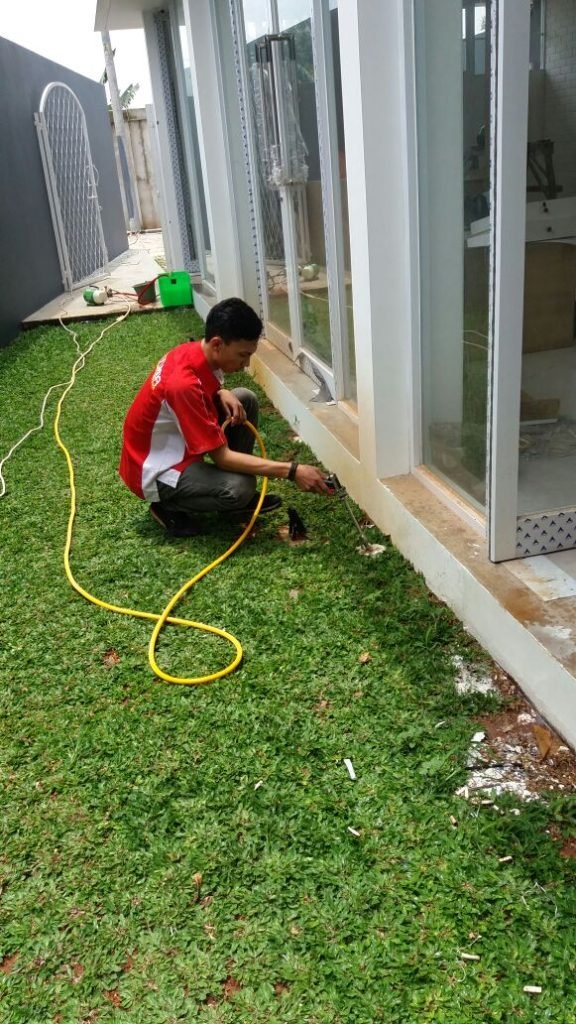
The Greater Jakarta Area Soil Treatment Protocols
The trench is excavated. The rod is inserted. The chemical is introduced. The technician moves 60 centimeters, then repeats. The ritual is repeated thousands or tens of thousands of times a year in Greater Jakarta. Both homeowners and exterminators believe it is an old-fashioned and tried-and-true method. It isn't. It's just a matter of tradition disguised as a protocol. Soil treatment for subterranean termites originated in temperate climates with different soil textures, diverse conditions of moisture, and a variety of species that are targeted. Transplanted to Jakarta's compacted silty clay, monsoon rain, and Coptotermes gestroi's foraging behaviors Traditional trench-and-drench methods produce outcomes that vary from transient suppression to total ineffectiveness. Greater Jakarta requires soil treatment protocols calibrated for Greater Jakarta's unique conditions. The following 10 points differentiate chemical treatment that simply generates invoice lines from treatment which actually does not exclude termites.
1. Chemical Mobility is determined by soil texture
Jakarta's urban land is predominantly made up of clay silty. Particle size smaller. Organic content is very low. Porosity is not too high. Liquid termiticides formulated for the substrate don't disperse radially as they do in loamy sands. They gather in the trench and move through preferred pathways, cracks and utility trenches, as well as roots channels. Pesticides who believe that they are distributed uniformly are flimsily assuming. It is not necessary to have faith in post-application soil core sampling.
2. The 300 to 500mm Moisture Belt determines the best placement
Roof eaves protect the soil adjacent to the wall of foundation. Rainfall is minimal. It is dryer than soil used for gardening. Termites' feeding activities are concentrated on the belt of soil 300-500 mm away from the structure. The area is close enough to allow termites to reach the foundation, yet far enough that they can get water. The belt is not reached by soil treatment that is applied in a flush manner with the wall. Trenching should be performed only at the dripline, not the wall.
3. Hydrolysis Half-Life Is Measured in weeks, not months.
Hydrolysis is the process by where fipronil (imidacloprid), bifenthrin, and imidacloprid get degraded. Temperature and moisture influence the rate of hydrolysis. Jakarta's soil temperatures average 28-32degC in shallow depth. During the majority of wet season, soil moisture is greater than 20%. Chemical half-life reduces in relation to. A product labeled for twelve-month efficacy in Ohio keeps about four months of field efficacy in Bekasi. This has to be stated in the guarantee. Most do not.
4. Vertical Barriers Require Horizontal Disruption
Termites can infest the soil as well as foundation interface. The soil treatment can only build a chemical barrier vertically if chemical is present at the surface. Surface injection of rods deposits chemical but does not treat the initial 5-10 centimeters. Exterminators that pound rods to the subsoil and then pull them up immediately treat the subsoil and leaving the topsoil untreated.
5. C-Organic Binds & Inactivates
Organic matter in soil adsorbs non-repellent termiticides and reduces the amount available for termite uptake. The urban areas of Jakarta have low levels of organic carbon. However, landscape plantings close to foundations are awash with a great deal of potting soil and compost. These zones require more intensive soil treatment in order to overcome the organic binding. The standard label rates are based on soils with mineral content that have not been modified.
6. Pre-treatment Moisture Audits Are Non-Negotiable
Habitats are formed when soil water content is greater than 22 %. Soil water levels lower than 10% are harmful to foraging, and also lower the amount of chemical absorbed. Exterminators who inject terminicide prior to measuring the soil's moisture use chemicals to unspecified conditions. The moisture meter costs two hundred thousand dollars. The first time a retreatment is required due to improper application conditions will cost 10 times the amount.
7. The Volume of the Trench Must Be Identical to Label Rate not Linear Meter
Indonesian soil treatment quotes are usually quoted per linear meter. Label instructions specify quantity and concentration for each square meter or per square meter of specified dimensions. If exterminators quote per meter, without checking the trench's width and depth, they are not selling treatment, but providing compliance documents. The volume of chemical required to treat a 15cm by 15cm is only half the amount needed for trenches 30cmx30cm. The price difference is rarely reflective of this.
8. Rodding Versus Trenching: A Specific Selection of Species
Coptotermes gestroi grazes in the top 15-20cm of soil. Microtermes insperatus grazes deeper, accessing water during dry times via vertical shafts. Rod injection deposits chemical at depth, intercepting Microtermes. Mixing and trenchching deposit chemicals on the upper side of the profile to stop the flow of Coptotermes. Species identification must precede protocol selection. Exterminators who use the same method of soil treatment for every case are half the time mismatched to Jakarta's species variety.
9. Re-treatment Intervals Are Shorter Than Marketing Claims
Indonesian market for pest control is very competitive. The selling strategy has resulted in an increase in warranty periods. Most soil treatment products have three-year warranty periods. The field conditions in Jakarta allow for a twelve- to 18-month timeframe of exclusion. This is followed by gradual depletion of the chemical as well as edge penetration. Termites breaking through in the month 22 isn't an uncommon event. Homeowners are following their timetable. Exterminators that honor warranty claims in month twenty-two, without disputing coverage, continue to serve their clients. Pesticides who challenge coverage lose customers.
10. After-Treatment sampling is the only reliable method for quality control.
The exterminator claims the trench was dug to the correct depth The chemical was mixed to an appropriate concentration, the injection was conducted at correct pressure, and the distribution was consistent. The homeowner is not provided with any way to verify. Verification comes from soil cores analysed for active ingredient content. There is a solution. This service exists. Jakarta antitermite services that request soil samples from third party companies and share the results with clients distinguish themselves on the basis of their evidence. Services that deny soil sampling differentiate themselves by faith. Markets are increasingly relying on proof.
Conclusion
The soil treatment protocols used in Greater Jakarta are not maintained because they are optimal for Greater Jakarta, but because they have become familiar. It is not enough to be familiar with them to assure the effectiveness of a treatment. The clay that is compacted in the city needs larger trench volumes than loamy soils in order to attain equivalent chemical distribution. The monsoon weather reduces the hydrolysis timeframe, which means shorter warranty terms and more frequent treatment cycles. The assemblage of species in this area requires protocol differentiation in accordance with pre-treatment identification. Landscape planting beds require organic carbon adjustments as well as greater rates of application. Foundation geometries that require trenching at the drip line and not wall line. Jakarta anti-termite businesses that provide soil treatments based upon the label of the manufacturer for Ohio Texas Osaka or guarantee results that are not optimal are at risk. The companies are not accountable for the results; the pest control company that did not adapt the protocol to the local environment is accountable. Adaptation is dependent on investment in soil moisture meters, core samples, connections with analytical laboratories, as well as the training of technicians in species identification. These investments are not optional in the mature market. It is the entry fee that must be considered seriously. Homeowners can discern the difference between exterminators from Greater Jakarta who paid this fee and those that did not. The homeowners of Greater Jakarta can distinguish between exterminators that have paid for this fee as well as those who did not. Follow the most popular anti rayap for blog info including jasa pest control, kitchen set anti rayap, kitchen set anti rayap, anti rayap terbaik, penyebab rayap di lemari, harga anti rayap, rayap rumah, kitchen set anti rayap, jasa basmi rayap, cara membasmi rayap kayu and more.
